Trigger Warning: Suicide
Call me morbid, and I totally am, but coming from San Francisco instilled the same macabre fascination with suicide in me that it did in Wittman. But here's the thing, the Golden Gate Bridge, this thing right here:
is the second most popular destination in the world for suicide. Over 1500 people have jumped off of it. It is so popular that people literally fly all the way to San Francisco just to use it as a means to an end. While millions come every year to take photos and stare and walk across the great Golden Gate, somewhere between 20 to 30 people on average every year come to the bridge just to jump off of it. I grew up just sort of expecting this to be a normal behavior. Dad went grocery shopping, there's a baseball game on, another earthquake, and ah yeah, someone jumped off the bridge again. It's common to the point of signs like these posted across the bridge:
Right now, a safety net is being built to catch people who do jump off the bridge. Which, when you look at the numbers seems like it's almost too little, too late. But it was actually argued against by some people for being too "unsightly". Because what really matters when people's lives are on the line is how pretty your damn orange bridge is, right?
Anyway, I think what I'm really curious about here is why. Why the Golden Gate? What is it about this bridge in particular that brings in so many desolate people? I also want to remind people that there are resources out there for you if you need help. The National Suicide Prevention Lifeline and other numbers and resources are available out there. No one is alone.
I spent most of my life growing up in Stockton. Yes, I've heard every joke in the book and made most of them myself: no, I'm not in a gang. Yes, there is gunfire at night sometimes. Once in middle school there was a shooting on the street right outside and the people at the dance inside turned up the music and kept dancing. There are some nice parts, but it's not the greatest city in the world (in fact, it was once the #1 worst place to live). But we do have an elementary school named after Maxine Hong Kingston.
As a youngster, I didn't know who "Hong Kingston" was. The other schools around the city are named things like Hazelton, Chavez, Hoover, King, etc., I assumed that whoever they were must be some king of political person I just hadn't heard of in class yet.
Maxine Hong Kingston was born in Stockton. She's what those of us who came from Stockton would refer to as "someone who escaped" and the city has rewarded her for this with a school, seemingly in the same way we honored Janet Leigh with a plaque in front of the movie theater because she went to school at the University of the Pacific.
But I didn't know any of this. I knew who Janet Leigh was, but couldn't even tell you the gender of the person they named that elementary school after. Her name is on a list next to Pullman, Adams, Kennedy, and nothing. Is it because she's a woman? Because the education system in Stockton isn't the greatest? Because she's a writer and not a president? It begs the question of who we see as important and why we think they are important. We put her name on something because she came from the city, but we don't assign her books. Is location more important than the person? It makes me wonder if we read Tripmaster Monkey because it's an important piece of literature, or because it happens to be set in San Francisco.
Stockton is mentioned a few more times in Tripmaster Monkey than it is in most other "San Francisco novels", probably because anyone who isn't from there likes to pretend it doesn't exist. In the first chapter of the book, Wittman says something about people thinking he's a "dentist from Stockton" (UOP has quite a good dental school). I find it interesting that San Francisco is the type of place you write about, Stockton is the kind of place you mention in passing.
Stockton is not San Francisco by any stretch of the imagination. There's no beautiful coastal views, International Orange bridges, or Beat poets. It's a place you leave to make art somewhere else. But that doesn't make the people who are from there any less than people from San Francisco. You don't suddenly start your life or become a Person when you finally get to San Francisco. Artists come from anywhere and anywhere can inspire art. SF is an important place, but it's only important because people make it that way.
George Watsky is a rapper, singer, songwriter, and slam poet who has preformed on Def Poetry and was named Youth Speaks Grand Slam Champion as well as Brave New Voices International Poetry Slam Champion in 2006. As a artist who spent his childhood in San Francisco during the '90s, The City is often a subject of his art. Most notably, Watsky wrote two songs that heavily feature San Francisco as a location: "Other Cities" and a remix of Foster The People's 2011 hit "Pumped Up Kicks"
"Other Cities"
There's nothin' like the feeling of the plane flight homeward;
The way my stomach dips when the landing gears lowered;
Because no matter how many miles that I wander;
The bay bridge curves like a smile on the water;
I'm like, what up missy?
Tell me you were missin' me;
With this pretty city skyline lit up like a Christmas tree;
The buildings shimmering like pinky rings from Tiffany's;
Every time I witness it I have a damn epiphany;
That this is me! This is where I've got the richest history;
Stacked with six or seven memories on every single street;
I never missed a beat;
I'm soaked in city pride;
And me oh my, this foggy sky got me misty eyed;
There might be other cities half as raw as ours;
(Just as 'bout it, 'bout it, 'bout it)
Out in some distant galaxy among the stars;
(But I doubt it, doubt it, doubt it)
We don't play tiny violins over minor things;
We slide into the ring takin' Tyson swings;
Because this city will defend our fuckin' pride
And raise each other up like Simba in the Lion King;
We're not shy;
I ain't no coy coward;
I'll be doin' trust falls offa Coit tower;
My boys on the ground floor providin' man power;
But if I die now, mix me into clam chowder;
Put me in a bread bowl, feed me to the seagulls;
But not the freakin' tourists;
I'm sure they're peachy people;
I guess I'm just a purist;
It isn't oil, but there's somethin' in the water
And it's got me feelin' diesel;
There might be other cities half as raw as ours;
(Just as 'bout it, 'bout it, 'bout it)
Out in some distant galaxy among the stars;
(But I doubt it, doubt it, doubt it)
[Outro: Bobby "Blue" Bland]
Ain't no love, in the heart of the city;
Ain't no love, in the heart of town;
Ain't no love, in the heart of the city;
Ain't no love, in the heart of town;
Ain't no love.
Excerpt from "Pumped Up Kicks [Remix]"
"At Buena Vista elementary in second grade
One whistle is when recess ends
Two whistles is an earthquake drill
Three means every kid better hit the deck
Unless you want to catch a stray bullet or a ricochet from a fight across the chainlink fence
I know that I don't look it but grew up in the middle of the city where only the quick make friends
A kid in Frisco
navigating Lombard
no On Star
I'm on BART
no lawn darts
not saying I'm hard
But I got street val for my Pokemon cards
Better put me onto Pawn Stars
And I'll Barter like my gramma when she wants art
Every block or two I skate around another beggar
Leaning on a cop car
Baked as a pop tart"
These two songs take subtly different looks at the city of San Francisco, where "Other Cities" celebrates the city's pride and community nature, "Pumped Up Kicks [Remix]" takes a look at the more dangerous nature of growing up in an urban neighborhood in the '90s.
"Other Cities" seeks to exemplify the beauty of the city, the memories he has formed growing up there and the pride and confidence of other San Francisco natives, while shunning the "freakin' tourists." In this sense, he is calling attention to the city in the contemporary moment, glorifying it and really drawing focus on many of the tourist attractions like the bay bridge, the Golden Gate, Coit Tower, as well as the cuisine ("clam chowder"). However, despite painting a picture of the city as this place of beauty and glory, he takes on an attitude that he deems "a purist:" against tourists ("I'm sure they're peachy people"), and adding that the city is itself a part of him.
Alternatively, his verse in "Pumped Up Kicks [Remix]" draws attention to the dangers of a child growing up in the urban environment of San Francisco. Watsky mentions his time at Buena Vista Alternative Elementary school, located on the corner of Portero Ave. and Cesar Chavez St., a few blocks away from the south side of the Mission district. He mentions the fact that his school necessitated a way to signal that a gun fight was occurring in dangerous proximity to the school's playground, and comments, "I know that I don't look it but grew up in the middle of the city where only the quick make friends."
Really, both these illustrations of San Francisco are equally correct and true, as a city as complex as San Francisco would have both both beauty and attractive qualities as well as danger and illegal activities that present a danger to visitor and resident alike. Similar to to the chapter of Reclaiming San Francisco, "You Are Here (You Think)," a city is more than the tourist attractions that appear on postcards, and the "metatourists" that toured the San Francisco's less photographic areas realized what a resident of The City knows from experience. As Watsky realizes, "That this is me! This is where I've got the richest history; / Stacked with six or seven memories on every single street;"
Last Friday I made a trip to the big city of San Francisco, primarily to drop someone off at the SF airport, but I knew it would be a good opportunity to go checkout some of the sites we have talked about in class, and maybe take some photos for a still-undecided final project. I drove up the 101 into the downtown high-rise buildings covering the east side of the peninsula, and I followed my phones directions off the freeway and down many one-way streets until at last I arrived at Columbus Avenue.
Driving up a slight incline on the diagonal street, I caught site of the City Lights Bookstore to my left, inhabiting a much larger building then it had in my imagination. I checked to my right for the possibility of a way-too-lucky parking spot, but it did not exist, so I thought "Of course, Columbus is a busy street," and made a turn off to the left into residential streets. But still no luck, cars everywhere, every seemingly empty space marked red or hiding a driveway. I turned left and right and left again, back past the bookstore lurking in my mind's eye as I tried to keep my sense of direction stable, driving every which way around and around. For twenty minutes, I kid you not. While trying to keep my frustration and road rage under the surface, I realized that San Francisco was not made for cars, and that I was not made for driving in the city.
I also realized that being in a car made the bookstore that much more inaccessible to me, and in fact if I had taken the bus or bart and walked it would have been much simpler. It made me consider my privilege as a college student to have a car, and the irony of the situation. Now of course I could have extended my parking search out a few more blocks in either direction (or paid $15-20 flat rate for parking) and I could have made it work. But it was nearing sunset and my "nice trip to the city" was quickly unraveling, so I gave up and moved on to North Beach where I spent time walking around Fort Mason and got dinner from a food truck selling creative grilled cheese sandwiches.
If I get the chance before the end of the quarter it would be nice to try this bookstore adventure again with more time and preparation, and have the chance to browse the literary selection and get my picture taken by the doorway, but in the mean time here is a picture that I did not take.
After the fires that followed the 1906 earthquake in San Francisco, writer Henry Fielding wrote this:
If, as they say, God spanked the town for being over-frisky,Why did he burn the churches down and spare Hotaling's Whiskey?
This was penned about the fact that the city's largest distillery escaped without any damage. I was reminded of this poem (shared with me by my high school APUSH teacher) in lecture the other day and I think it raises some interesting points about the incredibly varying cultures that thrive in San Francisco that are regarded as in need of divine correction. Something that has always interested me are the ways in which these cultures are and aren't visible to a layman. My visits into a city with people more familiar than I am had us strolling by men crowded around cafe tables talking in low voices (Soprano-esque is what I'm getting at here). I'm not saying Mobsters (or whatever that looks like in modern culture), but I am heavily implying it. Shadowy business done in broad daylight? Not my place to say. But it's a visible manifestation of the diversity that becomes apparent crossing from one neighborhood to the next.
Other sub-culture dealings are exemplified by the Kink.com acquisition of the historical San Francisco Armory -- Kink.com being an internet fetish company. The company claimed that they would be discrete and non-disruptive, but a women's shelter relocated after the purchase, citing discomfort with the company's presence. Additionally, the armory has been known to fly pride flags of various subculture, such as the leather pride flag below:
My point is this -- the different bubbling-ups of the subterranean subculture of SF are visible markers of the subversion and diversity the city is both prized and targeted for.
Last weekend, I asked a native San Franciscan to take me to City Lights Books for the first time. For them, it wasn't anything exciting– they'd been there before and go to the city a lot. For me, it was something new, an adventure. I somehow expected the experience to be enlightening in some way, to stand where so many people we talk about it this class had been.
And it was a bookstore. The kind of tiny, well-packed bookstore I love, but still simply a bookstore. There were dozens of copies of Ferlinghetti and Ginsberg and Kerouac around every corner, but it's not like their ghosts were standing in the corner with bottles of whiskey sharing stories and poems. They were reduced to bumper stickers (which I shamelessly purchased):
(not my picture, seeing as I don't actually have a car)
The teacher tried to point us to Kerouac Alley by finding a bar (which I did see), but it is literally right next to City Lights Books. When I was there, there was a man leaning on the wall with some bags, and nearby was a man holding a leash attached to a tiny pony:
It's not like there were students down there reciting poetry, men drinking and having sex, protestors or lovers– just a man and a small horse. City Lights and Kerouac Alley feel more like empty graves than anything. Walking past Chinatown, I didn't feel Kerouac talking about Buddhism over noodles. I quickly realized that the streets of San Francisco are too busy, too alive, too ever changing to still hold on to the images of the stories we read in "The Dharma Bums". The addresses might be the same, but the stories being told there are new. Those streets belong to the people of the present. The men walking their tiny horses, people in snazzy suits yelling to friends in mini-vans, and two UCSC students eating doughnuts and walking fast past tourists.
Our generation aren't the new Dharma Bums. We are the hipsters, writers, laughing friends whose stories matter just as much as anyone who's name is now a street within blocks of a bookstore. Rather than running around with books about Zen Buddhism and other religions, we treat the writings of Kerouac, Ferlinghetti, and Ginsberg like our new bibles.
This past Halloween, Joanna drove both of us up to San Francisco for a night. It's safe to say that it's a string of odd memories- there was a dude holla'ed at me from a bar spilling into the street, and I caught glimpses of painted women with shining pink light behind their eyes at the LAX/SFO art show. There was a brief journey into a neighboring Wes Anderson art show (and boy, was that an odd place to walk into, Bill Murray staring with blank eyes in various costumes along the walls). On our way back to my apartment, there was even a back-alley driving tour of San Francisco's graffiti art on our way out of the city.
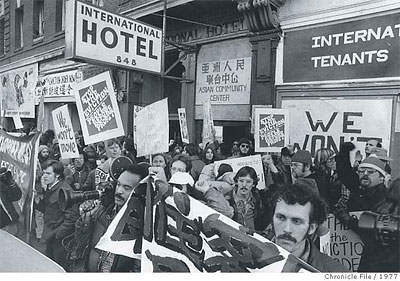
But the I-Hotel will always be my favorite part of that evening. Joanna and I had read an excerpt of the I-Hotel for a class last year, and we'd both loved reading about our culture. So she drove us over to the newly built center, where the previous I-Hotel had stood. What had been a thriving home for Filipinos and other Asian minorities in the area had faded from the intersection, with a Quickly's the only other marker of the Asian community in the block. It was hard to see where Manilatown had been.
Except for the I-Hotel, with a collection of lolos and lolas (grandfathers and grandmothers) taking a cigarette break outside its doors. There was a potluck going on inside (and how quickly did I feel at home.)
Here and here are articles about the opening of the new building- the original I-Hotel was demolished two years after the evictions of the elderly from the low-rent housing. We're all currently studying for our midterms on Tuesday, so I doubt we've cracked open Tripmaster Monkey, but I'm excited to start the reading as soon as I hand in my bluebook.